Research
Interests
I am broadly interested in water governance: how the way a water system is organized, financed, and managed shows up in its physical infrastructure and in the service that households actually receive at the tap. I care about the gap between how a system performs on paper and how it is experienced by the people who depend on it, and about the places, such as small and rural systems and fragmented sectors, where that gap tends to be widest.
I am currently exploring research directions in the Philippines, where water supply is delivered by a patchwork of water districts, local governments, private concessionaires, and community associations. I keep a comparative eye on small and rural systems in the United States, where I spent a year studying technology adoption and regionalization. My training is in engineering, and I want the work to stay anchored there: in measurable performance, in design decisions, and in tools people can use.
| Theme | What it covers |
|---|---|
| Governance and performance | How institutional arrangements translate into pressure, quality, continuity, and cost at the household |
| Small and rural systems | Technology adoption, technical assistance, consolidation and regionalization |
| Community-based methods | Fieldwork rooted in residents' experience, paired with utility and audit records |
| Open tools | Dashboards and web tools that make water and flood information plain and public |
Past research
-
Barriers to technology adoption in small and rural water systems
A multi-stakeholder interview study across utility operators, technology vendors, consulting engineers, technical assistance providers, and policy experts, analyzed with matrix coding to surface why promising technologies stall before reaching small communities. Alongside it, a regionalization cost analysis for Tennessee's Duck River watershed, built from permit records and historical State Revolving Fund requests.
2025 to 2026Washington, D.C. / remote -
Retrofit oxygenation technologies in wastewater treatment
Feasibility and performance testing of a retrofittable high-concentration dissolved oxygen delivery system at a fully operational treatment plant: comprehensive sampling (BOD, COD, nitrogen, phosphorus, TSS, ATP), statistical and machine-learning analysis of the links among dissolved oxygen, biomass activity, and sludge settleability, and a look at the barriers between innovation and adoption.
2023 to 2025Boise, Idaho -
Emerging contaminants across wastewater unit processes
How Idaho's wastewater systems handle pharmaceuticals, PFAS, microplastics, and other unregulated pollutants: where policy lags, what utilities carry, and how ready the infrastructure is. The work proposes a framework to guide future policy and investment.
2024 to 2026Boise, Idaho
In the field
Sampling days at an Idaho wastewater treatment plant during my master's work.
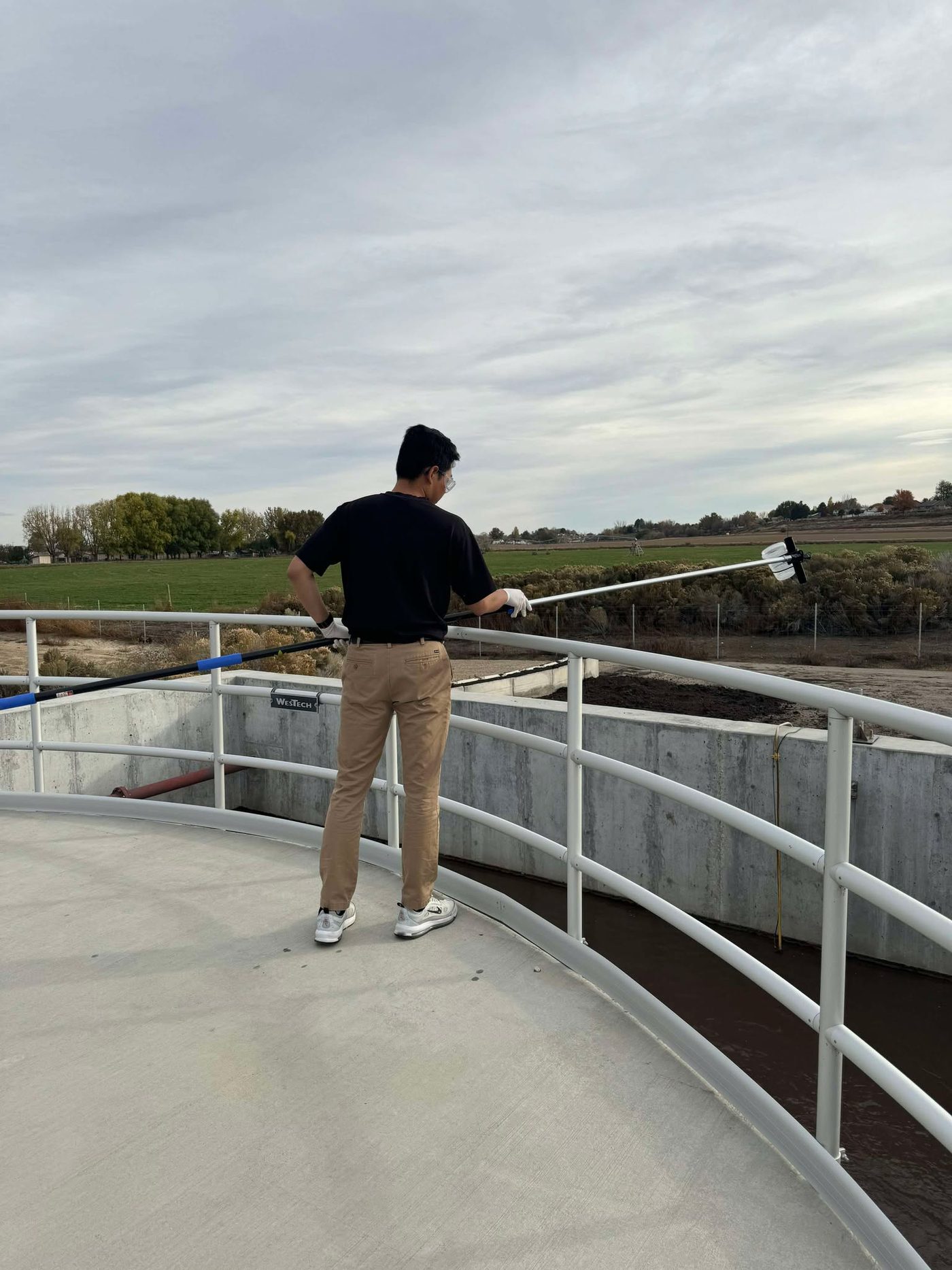
Activated sludge grab sample from an oxidation ditch. 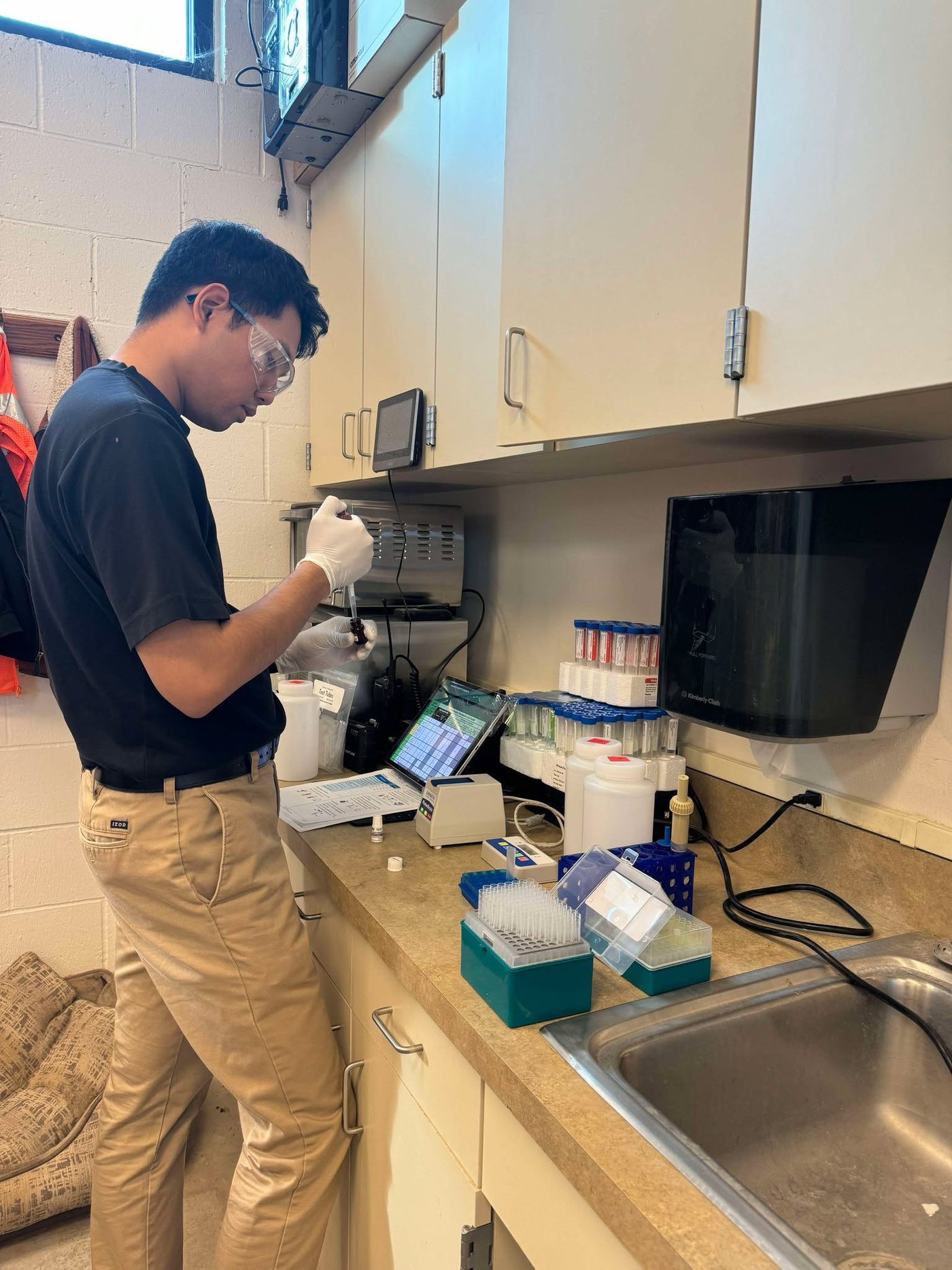
Bench work in the plant lab. 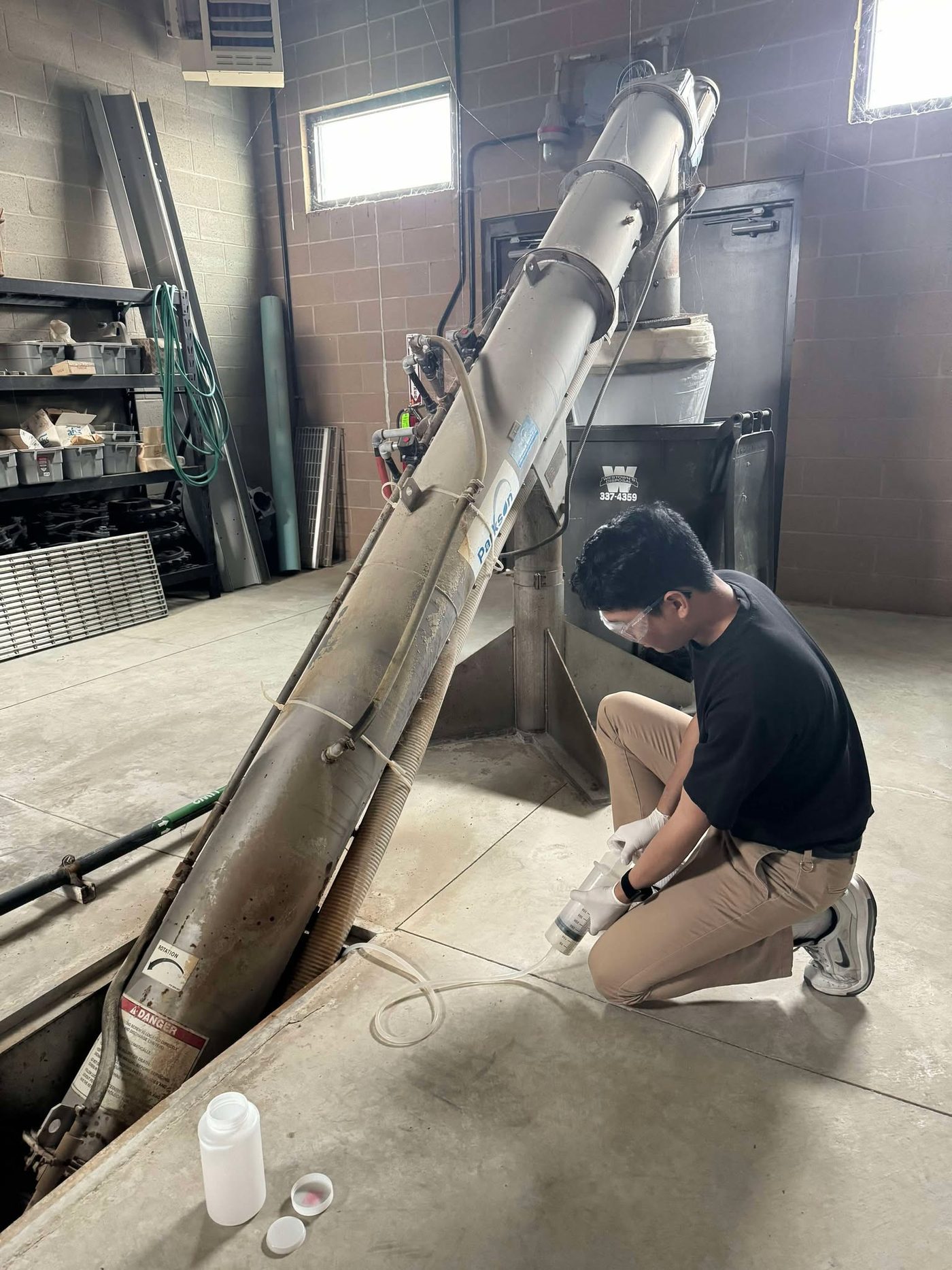
Drawing a sample at the headworks.
In the lab, sped up
Timelapses from lab days in graduate school. They play on their own while on screen, with no sound, and each has its own pause button.
Prepping samples at the bench. Setting out sample bottles. A titration, start to finish. Lab work in uniform. Refilling the carboy. A long day in the lab, from across the room.
Tools
I also build free web tools for public information, research and teaching, including the BahaWatch flood dashboard and virtual fluids labs.
Teaching
-
Lab instructor, CE 323: Environmental and Fluids Laboratory
Led hands-on sessions on water and wastewater quality testing (BOD, turbidity, pH, dissolved oxygen) and fluid mechanics, and taught students to analyze experimental data with statistical and graphical methods. Built the virtual fluids laboratories above for the course.
Fall 2025 -
Teaching assistant, CE 220: Coupled Environmental Processes
Spring 2025 -
Guest lecturer, CE 320: Environmental Engineering
Particle settling velocity distributions and isoconcentration contour plots, taught with beginner-friendly Python in Google Colab.
October 2024