The Motion and Structure of Singularities in General Relativity
Roger R. Posadas · Ph.D. dissertation, University of Pittsburgh · defended April 2, 1970
Roger's doctoral thesis, written at 25 under 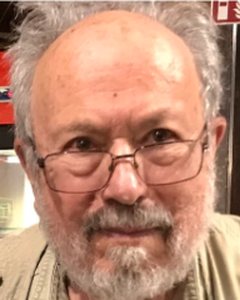 American physicist at the University of Pittsburgh and Roger's doctoral advisor. He co-created the Newman–Penrose formalism, a standard tool in general relativity, and found the Kerr–Newman solution for a charged, spinning black hole. Learn more (opens in a new tab)Photo: Kecchina, 2019 (opens in a new tab) · CC BY-SA 4.0 (cropped). It takes on one of the oldest questions in Einstein's theory of gravity: how does a body move?
The question
In Newton's physics you need two separate laws: one says how masses create gravity, the other says how bodies move under it. Einstein's Einstein's theory of gravity (1915), in which mass and energy curve spacetime and that curvature tells matter how to move. Learn more (opens in a new tab) is different. Its field equations, which describe how matter curves spacetime, also dictate how that matter must move, so a separate law of motion is not needed. Einstein and Jakob Grommer showed this for small test bodies in 1927, and In 1938 Albert Einstein, Leopold Infeld and Banesh Hoffmann showed that Einstein's field equations alone determine how heavy bodies move. Learn more (opens in a new tab) worked out the case of heavy bodies in 1938.
Turning that principle into actual equations of motion is hard. The standard methods of the 1960s pictured a flat, empty background spacetime with gravity as small ripples on top of it. The best earlier attempt to include electric charge, by Leopold Infeld and Philip Wallace in 1940, had to drop part of the theory and make arbitrary choices about which field belonged to the particle. Roger's thesis calls that method “unsatisfactory.”
The approach
Roger and Newman tried something different. They modeled a particle as a In general relativity, a place where quantities such as the strength of the gravitational field become infinite. Physicists often model a point particle this way. Learn more (opens in a new tab), a point where the gravitational field becomes infinite, travelling along a line through spacetime. From every moment on that line, All the paths a flash of light could take from one point in spacetime. Since nothing travels faster than light, it marks out everything that event can influence. Learn more (opens in a new tab) spread outward. Instead of measuring the particle against a flat background, they read its motion from the shape of that family of light cones, using the A mathematical toolkit for Einstein's general relativity, introduced by Ezra Newman and Roger Penrose in 1962. It simplifies calculations about black holes and gravitational waves. Learn more (opens in a new tab), the toolkit Newman had built with 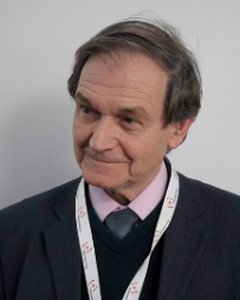 British mathematical physicist and Newman's collaborator, who won the 2020 Nobel Prize in Physics for showing that general relativity predicts black holes. Learn more (opens in a new tab)Photo: Cirone-Musi, Festival della Scienza, 2011 (opens in a new tab) · CC BY-SA 2.0 (cropped) in 1962. In the thesis's words, the method gives
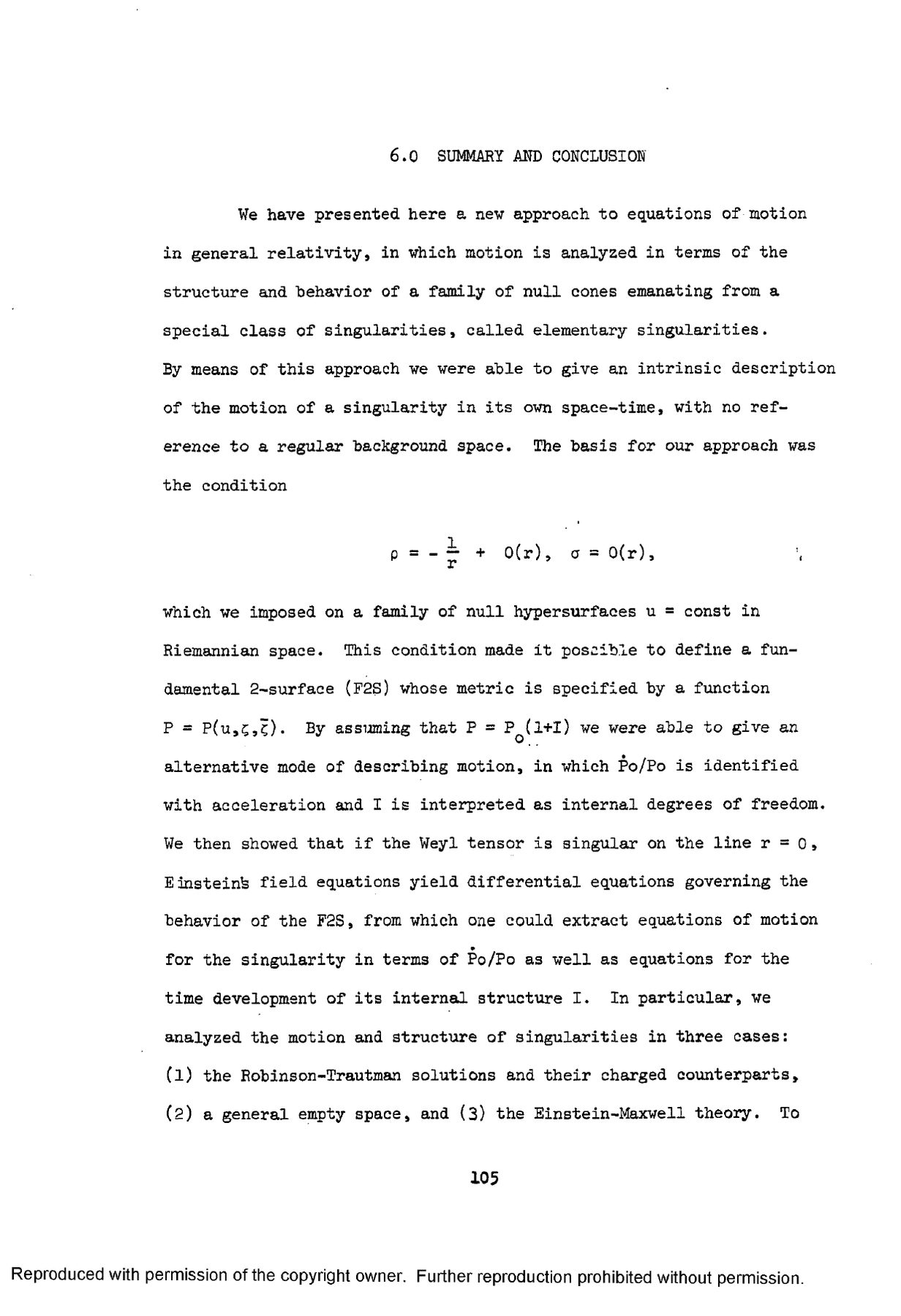
an intrinsic description of the motion of a singularity in its own space-time, with no reference to a regular background space.
He tested it in three settings: the Exact solutions of Einstein's equations, found by Ivor Robinson and Andrzej Trautman around 1960, that describe gravitational radiation pouring out from a bounded source along expanding light cones. Learn more (opens in a new tab) and their electrically charged counterparts; a general space empty of matter; and the full Einstein's general relativity combined with Maxwell's theory of electromagnetism, so that gravity and electric and magnetic fields act on each other. Learn more (opens in a new tab), in which gravity and electromagnetism act on each other.
What he found
Two results stood out. First, the singularity turned out to have an internal structure, with its own equation for how that structure changes over time: in this picture, a point particle is not quite featureless. Second, for a charged particle, the equations reduced, to lowest order, to the The equation of motion for an accelerating charged particle that includes the recoil from the radiation it gives off. Paul Dirac gave its relativistic form in 1938. Learn more (opens in a new tab), the classic law for a charge that loses energy by radiating as it accelerates. The radiation reaction force, which usually has to be put in by hand or rescued with A technique for taming infinities in physics. For a point charge, the infinite energy of its own field is absorbed into the mass we measure. Learn more (opens in a new tab), appeared on its own.
This derivation of the Lorentz-Dirac equation from the Einstein-Maxwell theory plus the discovery of an internal structure I for an elementary singularity constitute the major acheivements [sic] of our approach to equations of motion.
He closed by naming what was left to do: the full non-linear effects, particles that spin, and systems of two or more singularities interacting with each other.
The work also appeared as papers with Newman: “Equations of motion and the structure of singularities” (opens in a new tab) in Physical Review Letters and “Motion and structure of singularities in general relativity” (opens in a new tab) in Physical Review, both in 1969, with a sequel (opens in a new tab) in the Journal of Mathematical Physics in 1971.
Where, and with whom
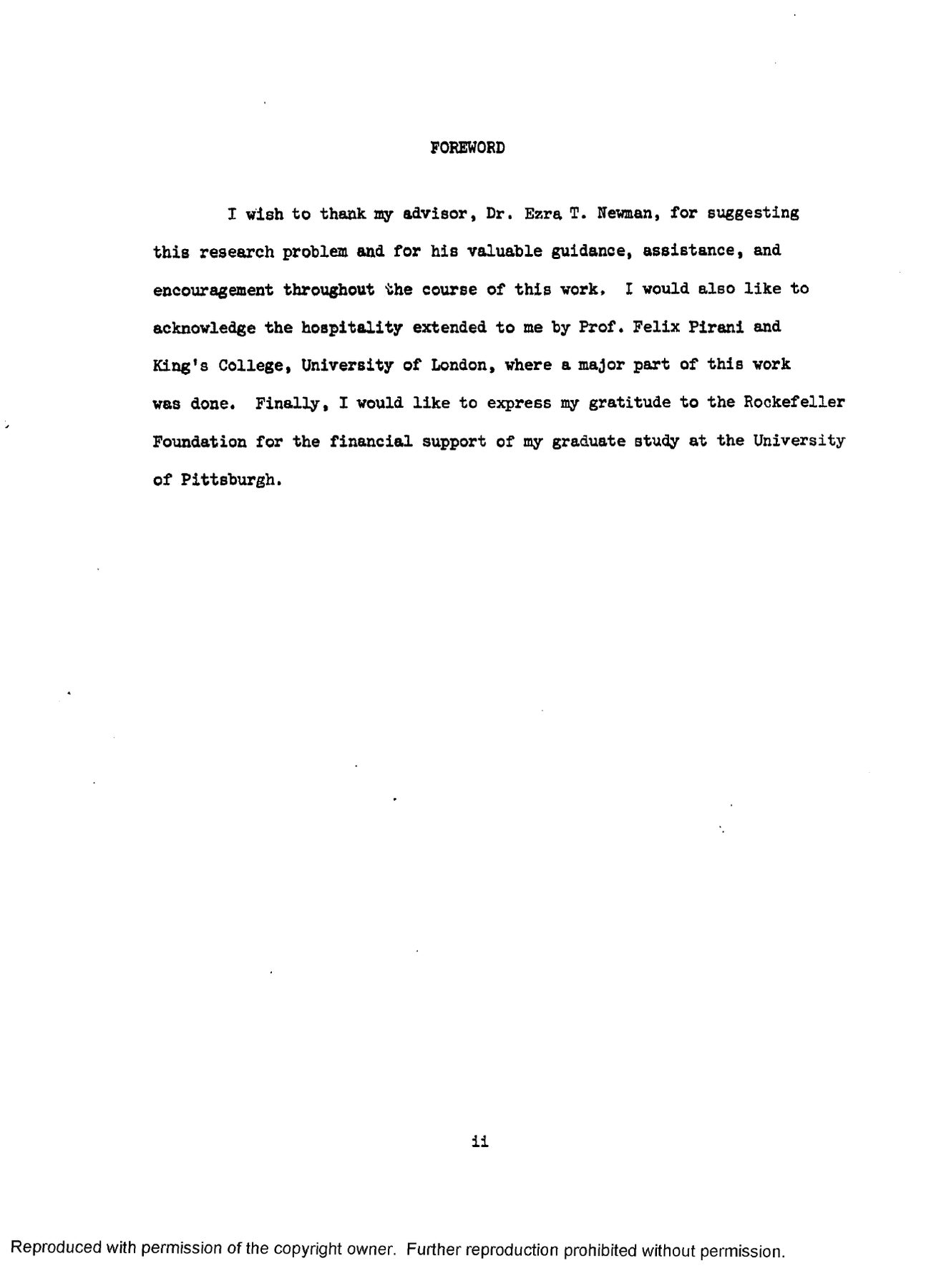
Roger came to Pittsburgh in 1965 on a Rockefeller Foundation fellowship and went straight for the doctorate, without a master's degree. A major part of the thesis was done in London, at King's College, where he was a guest of British physicist (1928–2015) at King's College London, one of the founders of the modern theory of gravitational waves. Learn more (opens in a new tab). The foreword, one paragraph long, reads in full:
I wish to thank my advisor, Dr. Ezra T. Newman, for suggesting this research problem and for his valuable guidance, assistance, and encouragement throughout the course of this work. I would also like to acknowledge the hospitality extended to me by Prof. Felix Pirani and King's College, University of London, where a major part of this work was done. Finally, I would like to express my gratitude to the Rockefeller Foundation for the financial support of my graduate study at the University of Pittsburgh.
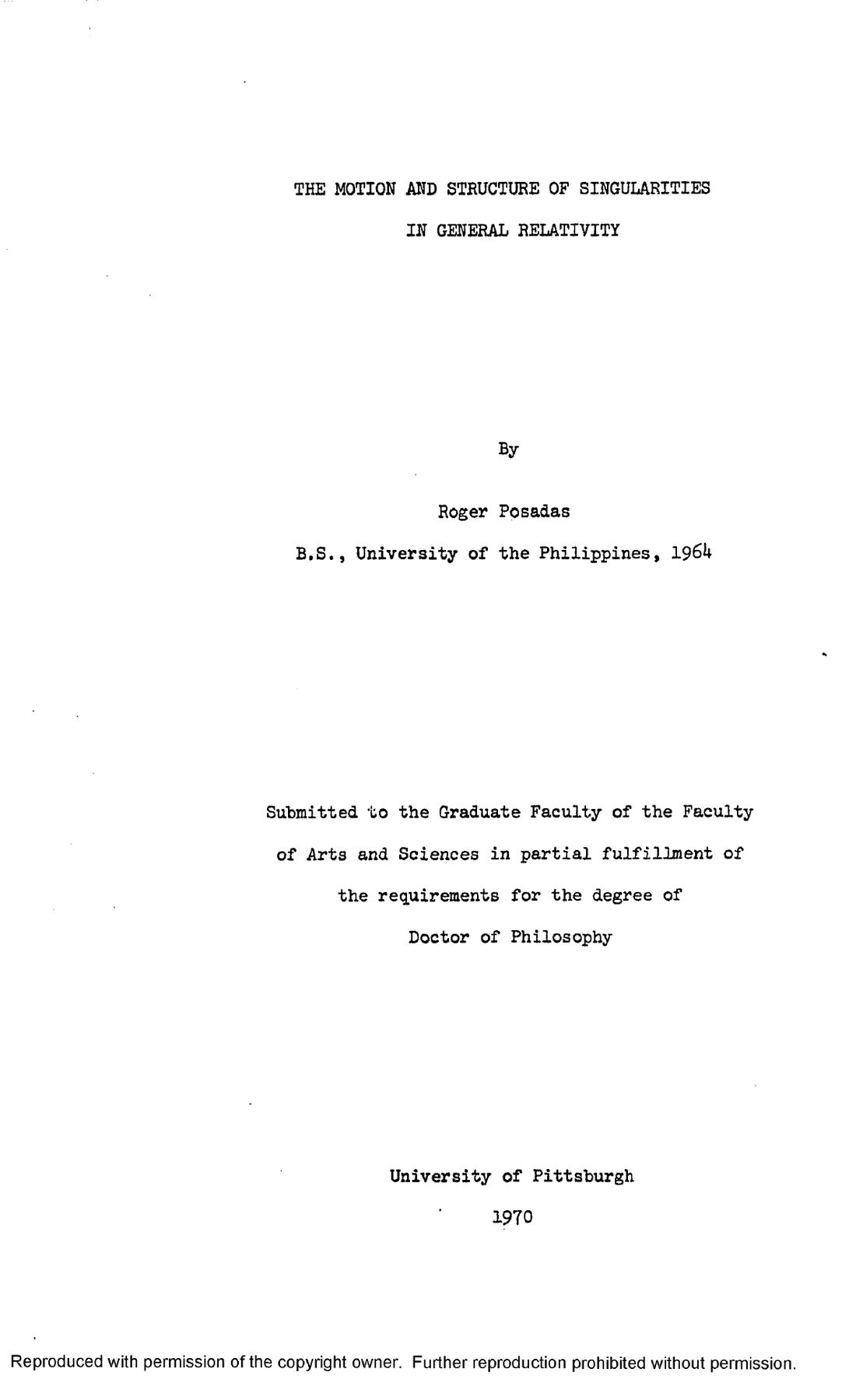
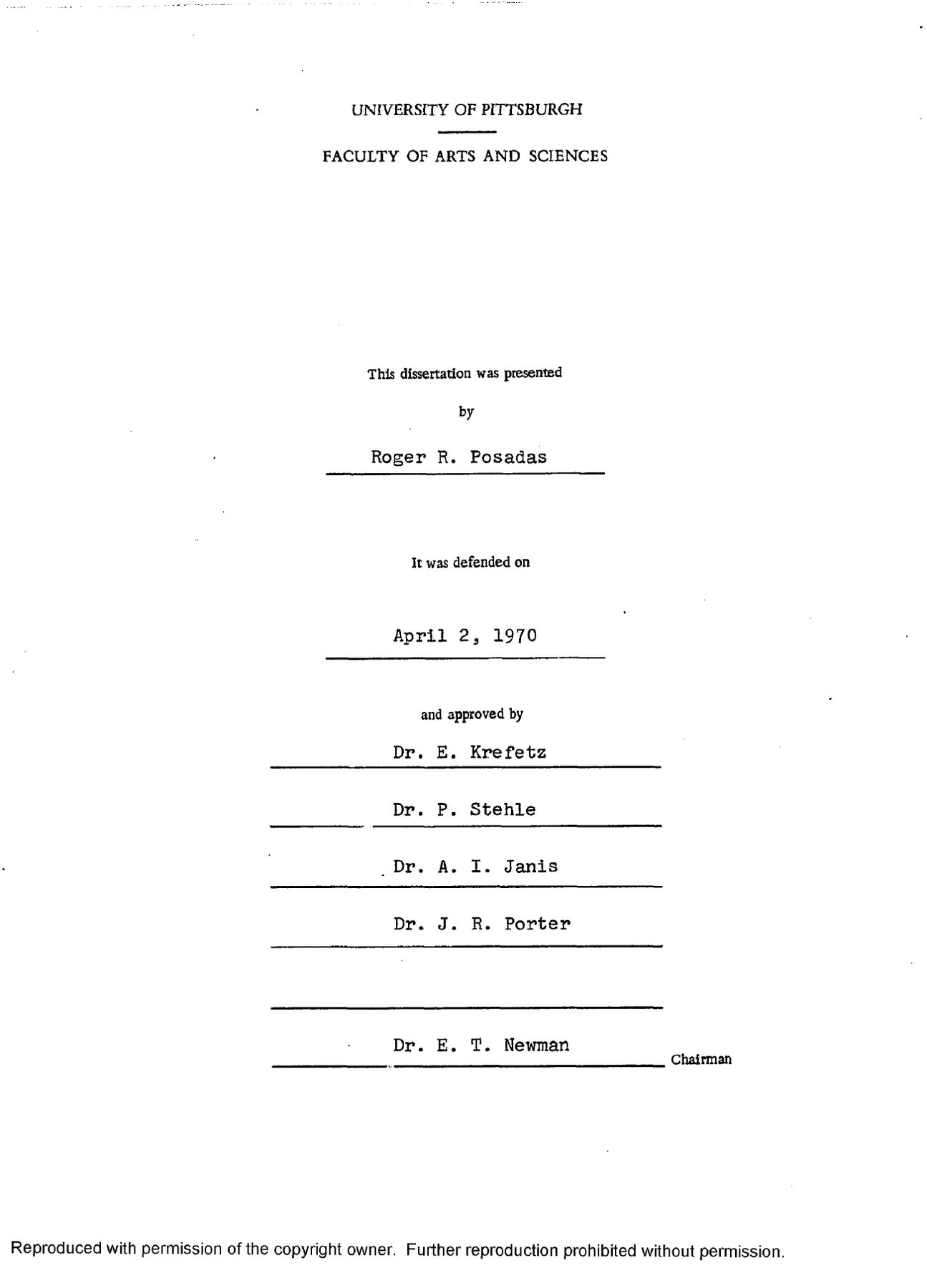
He defended on April 2, 1970. His committee was Ezra T. Newman, as chair, with Physics professor at the University of Pittsburgh and one of Roger's teachers, known for the Newman–Janis method in general relativity. Learn more (opens in a new tab), P. Stehle, E. Krefetz and J. R. Porter. The title page gives his name as Roger R. Posadas, with one earlier degree: “B.S., The national university, founded in 1908. Its flagship campus is Diliman, in Quezon City, Metro Manila. Learn more (opens in a new tab), 1964.”
| Chapter | Page |
|---|---|
| 1. Introduction. The problem of motion, from Einstein to the late 1960s. | 1 |
| 2. General formalism. The spin-coefficient formalism, spin-weighted spherical harmonics, a special null coordinate system, and the basic assumptions. | 9 |
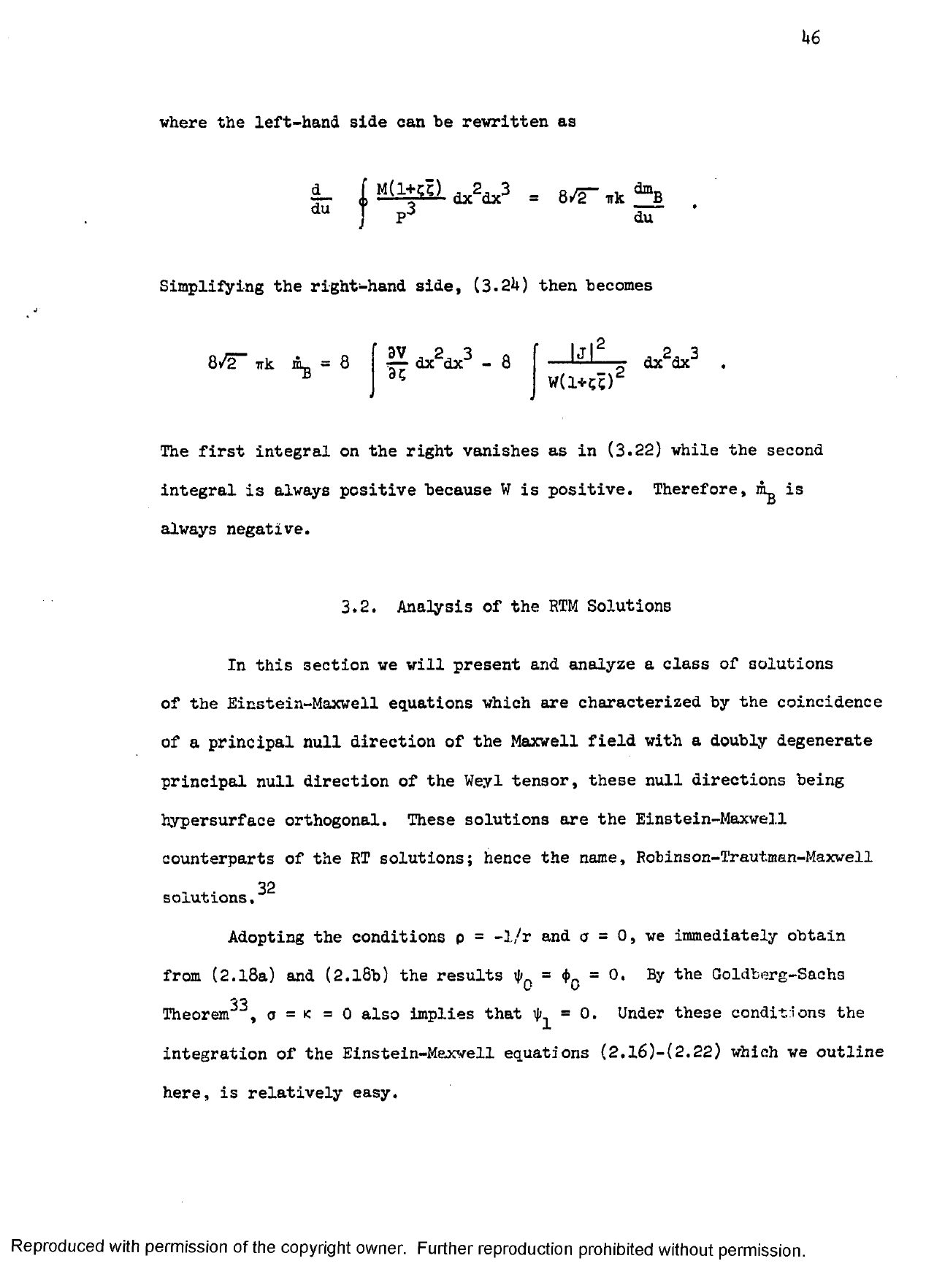
| 3. Motion of free singularities. The Robinson–Trautman solutions and their charged, Robinson–Trautman–Maxwell counterparts. | 37 |
| 4. Motion in a general empty space. | 59 |
| 5. Motion in the Einstein–Maxwell theory. | 83 |
| 6. Summary and conclusion. | 105 |
| Appendices A to C, and references. | 107 |
Pages from the dissertation
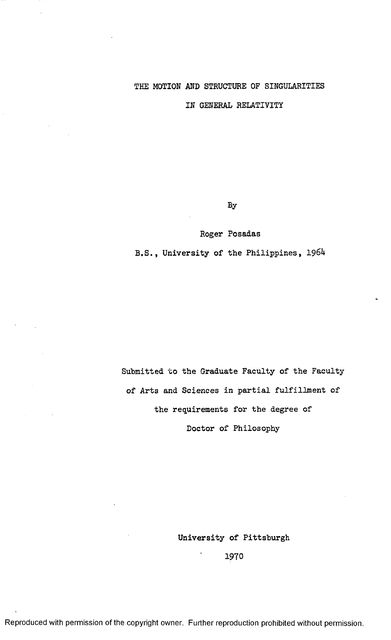
The title page. 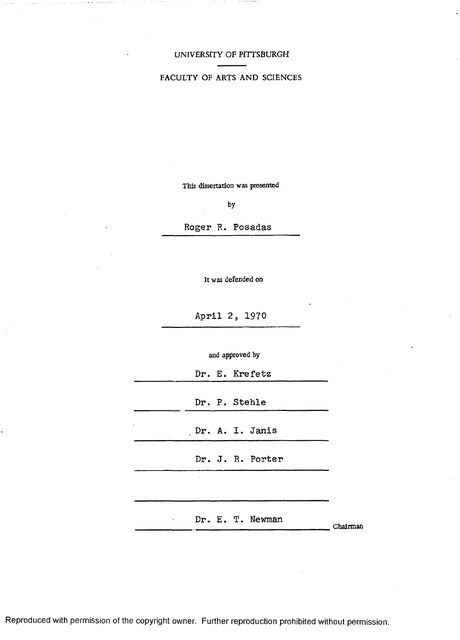
Defended April 2, 1970, before his committee. 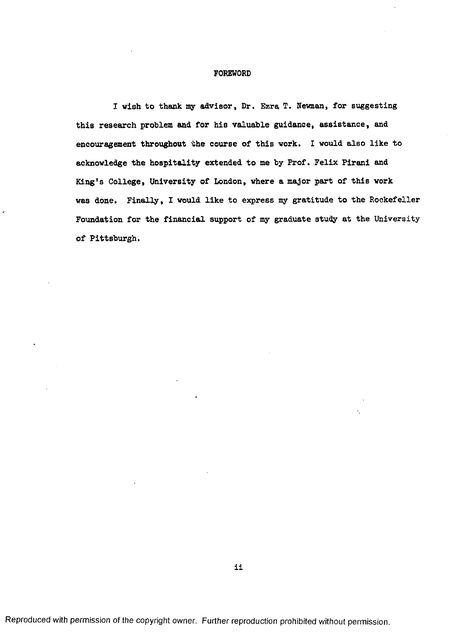
The foreword. 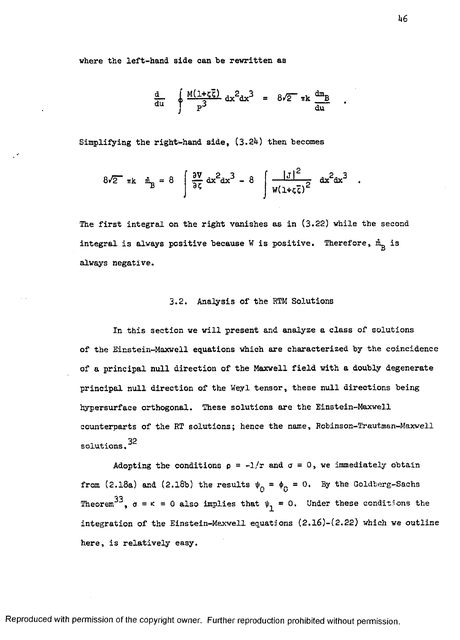
Page 46, from chapter 3. 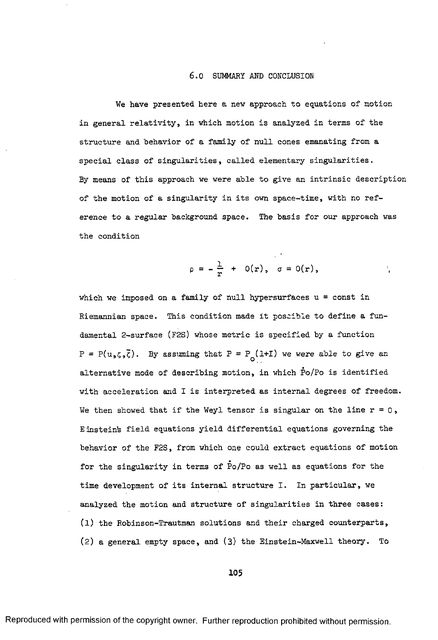
Page 105: the summary.
This is the University Microfilms scan of the dissertation (order no. 70-20,354), posted by his family. Its text was recognized by machine, so equations and some words will read poorly with a screen reader.